BOTOX INJECTIONS
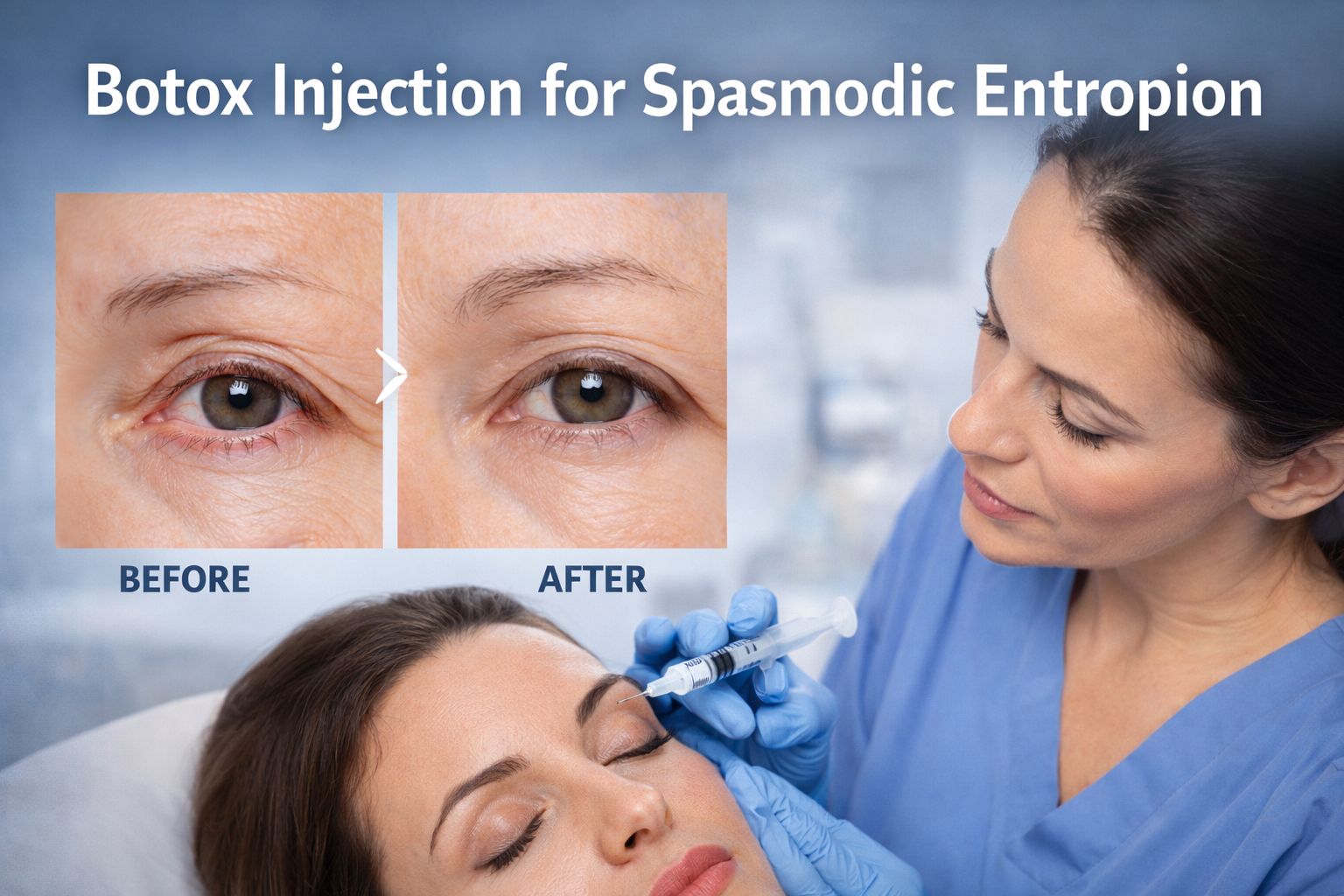
Spasmodic entropion occurs when acute ocular irritation triggers a sustained contraction of the orbicularis oculi muscle, causing the eyelid margin to invert. This leads to Redness and irritation, excessive tearing, gritty or painful eyes, sensitivity to light, recurrent infections, or corneal damage. At our clinic, we provide a sophisticated, non-surgical approach using Botulinum toxin to interrupt this cycle and restore eyelid positioning.
Diagnosis
Before intervention, a comprehensive ophthalmic examination is required to distinguish spasmodic entropion from involutional or cicatricial variants.
-
Snap-back & Distraction Tests: Assessing the horizontal laxity of the eyelid.
-
Trigger Identification: Evaluating for underlying causes such as trichiasis, ocular surface disease, or post-surgical inflammation.
-
Muscle Hypertonicity Evaluation: Confirming the overactivity of the preseptal orbicularis muscle.
Surgical Intervention
The injection process is rapid, minimally invasive, and performed under high-precision clinical conditions.
-
In-Office Procedure: No general anesthesia is required; a topical numbing agent is applied for comfort.
-
Injection Technique: Utilizing ultra-fine needles to deliver the toxin directly into the preseptal orbicularis oculi.
-
Immediate Recovery: The procedure takes less than 15 minutes, allowing patients to return to daily activities immediately.
Consultation and Education
We believe an informed patient is a confident patient. During your consultation, we bridge the gap between clinical data and your personal recovery.
-
Mechanism of Action: We explain how the neurotoxin inhibits the release of acetylcholine at the neuromuscular junction, effectively “quieting” the muscle spasm.
-
Prognostic Expectations: Discussing the temporary nature of the injection (typically lasting 3–4 months) and its role as both a primary treatment and a diagnostic trial for future surgery.
Postoperative Care
Post-injection care is streamlined to ensure the toxin settles correctly and the ocular surface begins healing.
-
The “Rule of 48”: Patients are advised not to rub the injection site for 48 hours to prevent toxin migration.
-
Onset of Action: Patients typically observe a reduction in eyelid inversion within 72 hours, with peak efficacy reached at 14 days.
-
Corneal Rehabilitation: Use of preservative-free lubricants to heal any abrasions caused by the prior entropion.
Treatment Planning
No two eyes are identical. We utilize a bespoke mapping technique to ensure optimal results with minimal side effects.
-
Dosage Titration: Determining the exact units (typically 5-15 units) required based on the severity of the spasm.
-
Site Mapping: Identifying the specific lateral and medial sites on the lower eyelid to prevent complications like ectropion (eversion) or lagophthalmos.
Ongoing Management
While Botox provides significant relief, we manage the condition with a view toward long-term eyelid health.
-
Maintenance Cycles: Scheduling repeat injections every 3 to 6 months if the underlying trigger remains.
-
Surgical Transition: If horizontal laxity is severe, we discuss how this temporary paralysis serves as a “bridge” to definitive surgical repair, such as a Lateral Tarsal Strip procedure.
Speak with an Ophthalmologist
Call: +44 7900 842692


Frequently Asked Questions
How does Botulinum toxin physically correct an inverted eyelid?
The injection acts as a localized neuro-modulator. It blocks the release of acetylcholine at the neuromuscular junction of the preseptal orbicularis oculi. By inducing a temporary, controlled paralysis of this muscle, the spastic force pulling the eyelid inward is neutralized, allowing the eyelid margin to return to its natural apposition.
Is this a permanent solution for my entropion?
Botox is a highly effective temporary intervention. While it provides immediate relief from corneal scraping, the effects typically last between $3$ to $6$ months. It is often used as a “bridge” therapy to provide comfort while underlying inflammation is treated, or as a diagnostic tool before committing to a permanent surgical lateral tarsal strip.
How soon will I notice a reduction in ocular irritation?
Most patients begin to feel a reduction in muscle tension within 24 to 72 hours. Complete resolution of the eyelid inversion and the associated “foreign body sensation” usually occurs within 1 to 2 weeks as the corneal surface begins to heal.
What are the clinical risks associated with these injections?
As a minimally invasive procedure, risks are low. However, potential side effects include localized ecchymosis (bruising), temporary ptosis (drooping of the upper lid), or lagophthalmos (incomplete eye closure). Our precise site-mapping technique is designed to minimize these risks.
Will the injection affect my vision or my ability to blink?
The treatment is highly targeted. We inject only the specific fibers of the orbicularis muscle responsible for the spasm. While your blink may feel “softer” or slightly different, your ability to protect the eye and maintain a proper tear film is generally preserved.
Can I undergo this procedure if I have a history of dry eye syndrome?
Yes. In fact, spasmodic entropion often exacerbates dry eye by damaging the corneal epithelium. By correcting the lid position, Botox often allows the ocular surface to retain lubricants more effectively. We will monitor your tear film stability closely post-injection.
Is the procedure painful?
Discomfort is minimal. We utilize a topical anesthetic and ultra-fine gauge needles. Most patients describe the sensation as a brief, minor pinch. No sedation or regional nerve blocks are required.
What happens if the Botox migrates to other muscles?
Migration is rare when the injection is performed by a specialist. To prevent this, we advise patients to remain upright and avoid rubbing or massaging the orbital area for at least 4 to 6 hours following the session.
How many units of the neurotoxin are typically required?
Dosage is customized based on the muscle mass and the severity of the spasm. Typically, a dose ranging from 5 to 15 units is sufficient to achieve the desired chemo-denervation without causing complete lid laxity.
Why choose Botox over immediate surgery?
otox is an excellent “non-surgical trial.” It allows the clinician to determine if the entropion is purely spasmodic (triggered by irritation) or if there is significant horizontal laxity that requires a more invasive surgical repair. It provides immediate relief with zero downtime.
What to Expect From Your Visit
Comprehensive Eye Examination, Refraction Test, Slit Lamp Examination, Dilated Eye Examination, Additional Specialized Tests,Diagnosis and Treatment Plan, Patient Education, Follow-Up Appointments. It’s important to note that the exact procedures and tests may vary based on individual needs, and some visits may focus on specific concerns or conditions. It’s always beneficial to communicate any specific symptoms or concerns you may have during the visit.